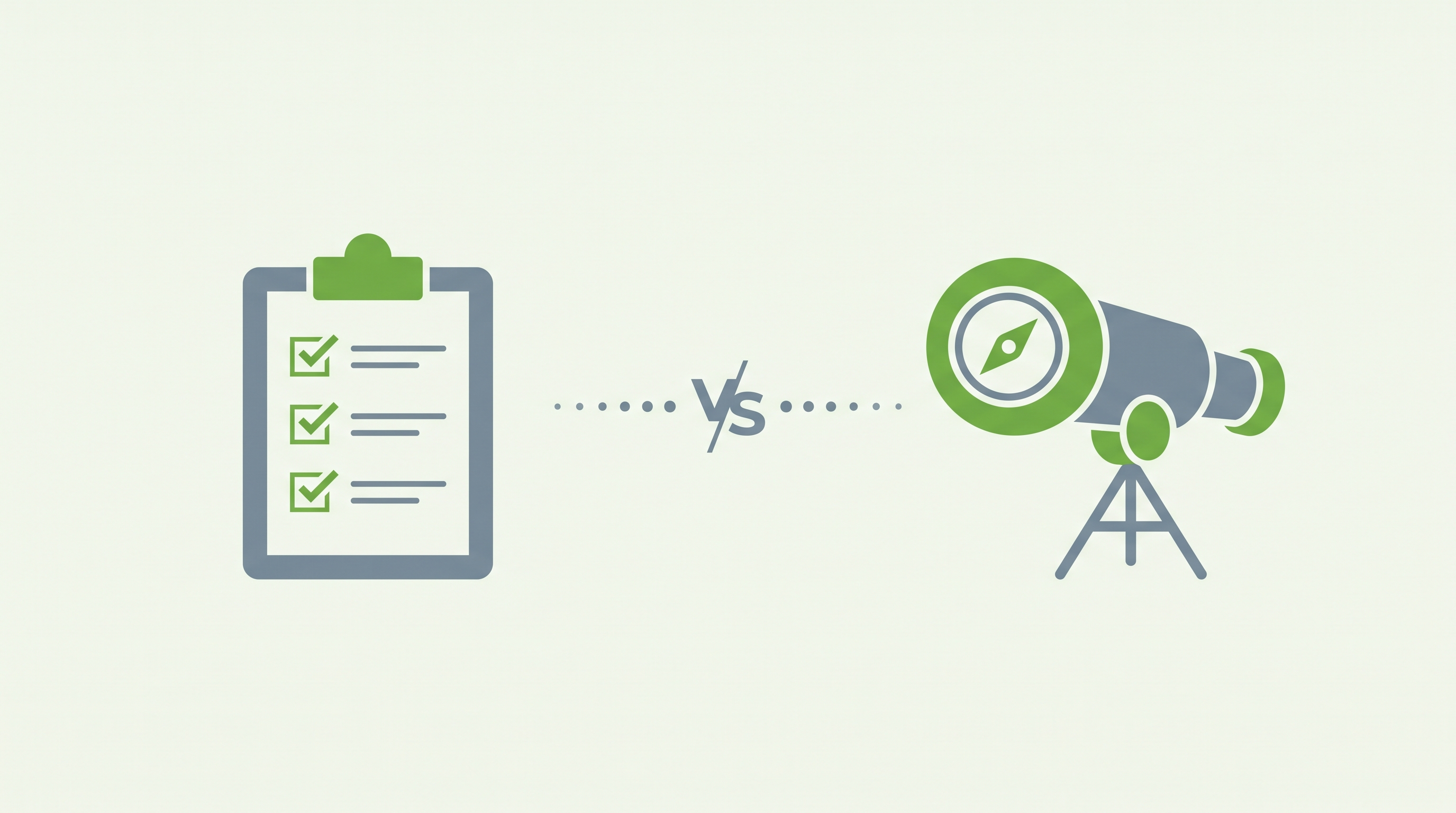
The difference between product owner and product manager comes down to focus. In the textbook, a product manager decides what gets built and why, and a product owner turns that into a backlog the development team can work from.
In practice the two roles overlap a lot, and product owner versus product manager comparisons rarely agree, because definitions vary between companies.
Below is the textbook product owner vs product manager split, followed by the view of our founder, Mohamed Alkaduhimi, on whether it holds up in practice.
What is a Product Owner?
A Product Owner owns the product backlog: they decide how the work is broken down and in what order it gets done, working closely with the development team. They own the “how” and the “when.”
The role comes from Scrum, where the Product Owner turns the roadmap into scoped tickets, clear priorities, and answers ready when the team hits a question mid-sprint.
What is a Product Manager?
A Product Manager owns the product strategy: why something is built and what gets built. They own the “why” and the “what.”
That means setting the strategy, deciding which problems are worth solving, and connecting the roadmap to business goals. It also means talking to customers, watching the market, and deciding what gets built next, and what doesn’t.
Product Owner vs. Product Manager: the key differences
Side by side, product manager vs product owner looks like this in the textbook:
- Time horizon: Product Managers think in quarters and years. Product Owners think in sprints and weeks.
- Audience: Product Managers talk mostly to customers, leadership and the market. Product Owners talk mostly to the development team.
- Decisions: Product Managers decide what problem is worth solving. Product Owners decide how that problem gets broken into workable pieces.
- Origin: Product Manager is a general business role. Product Owner is a specific role defined by Scrum.
On paper, that is a clean split. This article is based on an interview with our founder, Mohamed Alkaduhimi, who explains how it works in reality. His words are quoted as he said them, lightly edited for length and clarity.
Why Wise Minds does not split the two roles
At Wise Minds there is no separate product manager and product owner. Mohamed’s reason comes from experience, not from the textbook.
At Wise Minds we don’t make a distinction between product manager and product owner. It’s nice in theory. But in reality, when you have both roles, I have never seen it work in favour of role clarity.
The gray area is bigger than the clear-cut area. And most people don’t operate, or build a product, in a way where this distinction can even be made.
His advice to teams follows from that.
I advise against separate product managers and product owners. It’s for the sake of better ownership and clarity in the team.
Why clients ask for one role and need a team
The same pattern shows up when a client first contacts us. It usually starts with a request for a single technical role.
Sometimes a client is really searching for just one technical role. This is because they’re focused only on increasing capacity, and that feels like the most logical quick patch.
Getting a client away from that one fix is hard, Mohamed says.
It’s hard to get them out of the fixation on this one solution, so they can think about what they actually need instead of a specific tactic.
It’s very hard to convince them that they also need someone to manage the project. They feel that they, or their current team, can manage extra people.
The reality is that this isn’t true. Their current team is having the problems it has because they’ve been trying to add people to the main team.
Many people see another project manager or product owner as overhead. Mohamed disagrees.
They think it’s a lot of overhead and not worth it. But it is worth it. It’s what makes it possible to scale up capacity that would otherwise not work out.
What changes once the new team starts working
The effect becomes visible as soon as the new team is working.
Once the new team is running, clients see the interaction between the new team and the first team. And they see how much value is in it.
Both teams can work separately and autonomously. There is completely new leadership and an asynchronous process, and it really works.
The restructuring lets you scale linearly. Trying to add people to a single team will plateau.
An example: a scale-up in the Netherlands
Mohamed describes how this played out for one client.
We did exactly this for a scale-up in the Netherlands. In the beginning they were very concerned about the number of people we were adding. I got the feeling they weren’t really convinced, but they did want to try it.
The moment they saw it working, it was clear this was very different from what they had tried before. We restructure the complete process instead of adding things to it.
How this differs from team extension
It is easy to mistake this for team extension, where an agency adds people to your team. Mohamed draws a clear line.
Other agencies add people to your team, like a team extension. This is not team extension. It’s a separate product unit working alongside another product unit.
For that to work, your current team first needs to own a certain part of the product, instead of trying to own the complete product. Then we fit in next to it.
What this means for your team
If your team is already stretched, the pattern Mohamed describes is worth taking seriously: adding people to the main team can be part of the problem, not the fix.
This is how our product units work, without a hard split between Product Owner and Product Manager.
If the missing piece is the strategic side, see our product management as a service. If you need engineering capacity too, see hiring a development team.
Once you know who owns what, the next question is how to structure the rest of the team. See our guide on how to structure a software development team.
About the interviewee: Mohamed Alkaduhimi is the founder and CEO of Wise Minds and the host of the Scaling With Purpose podcast.
Frequently asked questions
What is the difference between a Product Owner and a Product Manager?
In the textbook, a Product Manager owns the strategy: why something is built and what gets built. A Product Owner owns the backlog: how the work is broken down and when it gets done, working closely with the development team.
Are a Product Owner and a Product Manager the same?
In the textbook, no: they are two roles with a different focus. In practice the two overlap, and many companies use the titles interchangeably.
Is the Product Owner a Scrum role?
Yes. The Product Owner is a defined role in Scrum. Product Manager is a general business role and is not part of the Scrum framework.
Is a Product Owner more junior than a Product Manager?
Not necessarily. It is a different focus, not a different seniority level. Some Product Owners are highly senior and run the backlog for complex, high-stakes teams.
Can one person be both Product Owner and Product Manager?
Yes. In practice many teams, especially smaller ones, combine the two, and many companies use the titles interchangeably.
What is the difference between a Product Owner and a Project Manager?
A Project Manager owns the delivery of a project: scope, timeline, budget and risks, until it is done. A Product Owner owns the value and the backlog of a product, which keeps going after any single project ends.